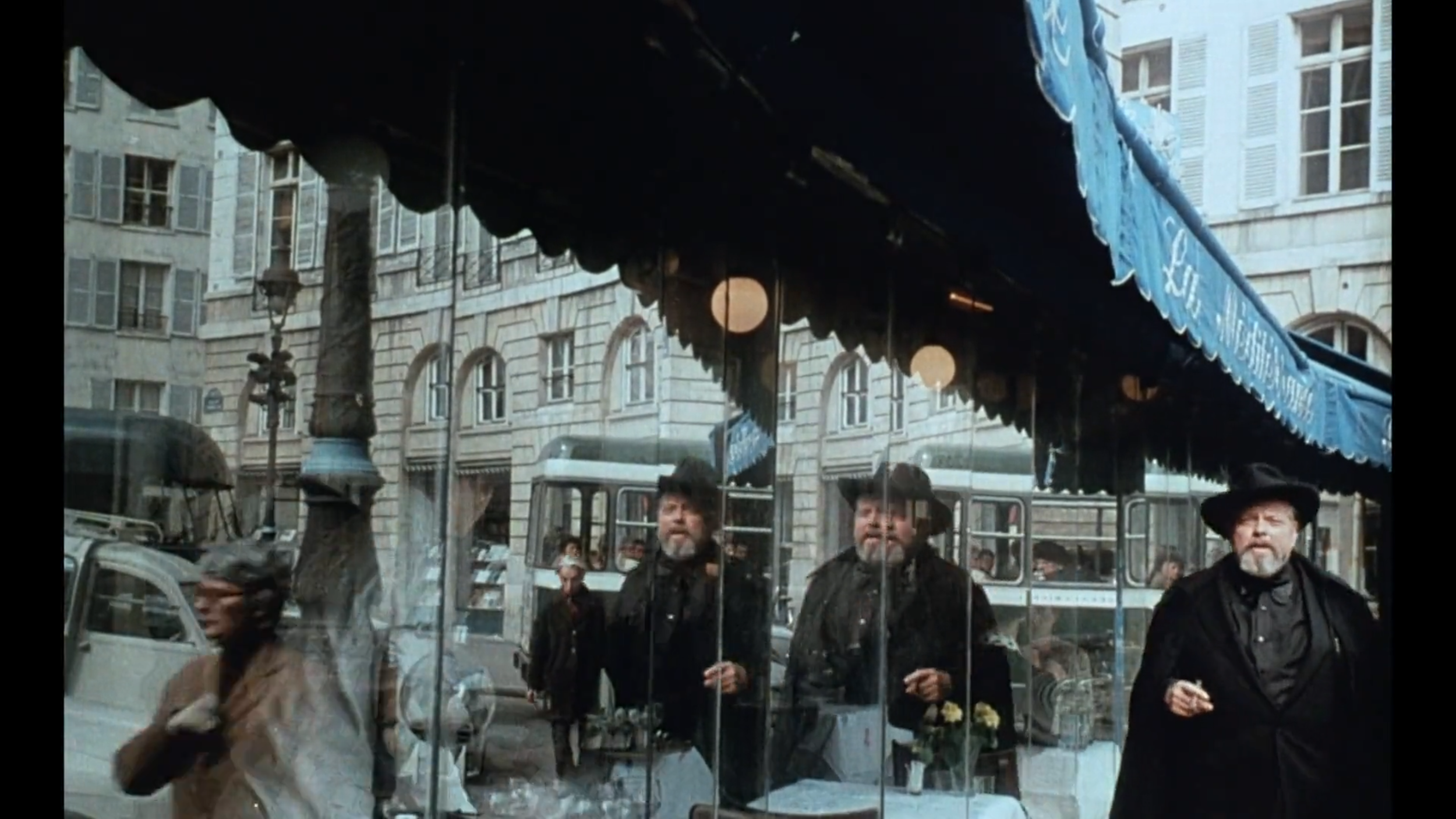
F For Fake (1973). Director: Orson Welles. Runtime: 1h 35m. [Youtube]
It is extraordinarily difficult to know what to make of Orson Welles's F For Fake (1973), which constantly threatens to splinter, to shatter in on itself, much like the famous mirror scene in his much earlier effort, The Lady From Shanghai (1947), cutting hither and thither, never allowing the viewer to rest in anything resembling epistemic certainty. Here is Welles's foray into the genre of the mockumentary, avant la lettre, which he must be said to have invented with Fake. It may also be considered, as some critics have postulated, an essay film (some claim Welles said so himself, though this is probably apocryphal, fittingly for a film about the uncertainty of knowing). But to place it in this category presupposes that, as in an essay, there is a clear thesis being advanced. The key to understanding the late, mature Welles, however, is to recognize his absolute lack of self-seriousness, seeming to exclude anything quite so ponderous as an argument or thesis.
The fallacy of film theory, like all theorizing that has reached a sufficiently advanced stage is that it tends toward bloodless, lifeless abstractions, and so does not make sufficient room for physicality: the smile, the crinkling of the eyes, the laugh—the body, in short. The secret of Welles at this stage in his career is an aspect so seemingly trivial: his charm, his belly laugh, his great guffawing outbursts, undermining all masterful authority, in evidence in multiple public appearances throughout the 1970s and 1980s—on the Dick Cavett Show in the '70s, for instance, or in a Q&A session with French film students in the early '80s. Famously, Welles suffered an expulsion from Hollywood—a rejection by the same industry that launched him onto the world stage—and to laugh after such suffering is perhaps the greatest achievement of his career.
In Fake, there is no thesis or hypothesis as such, but a loosely assembled reel of ruminations, which, though roaming far and wide, trotting the globe and traversing the quasi-mystical figure of Elmyr de Hory—a real-life art forger of whom one can never be quite sure whether he really existed—is never intended to be taken very seriously at all. And yet, the paradox, of course, is that Fake's anti-seriousness is foundational, and so is in a certain sense very profound indeed. If the film is nothing but pure reversal, including a negation of negation itself, then even its anti-seriousness must be inverted, flipped on its head…
Montaigne wanted his readers to come away with a certain viewpoint—the essayist's own view, though sometimes hazy, but always in some way definitely present. Welles's Fake, on the other hand, never digests its dizzying array of image-morsels and sound-scraps. There is no there there: the whole thing is an escapade, a romp—as evidenced in the playful filmmaker's solemn vow to his audience at the outset of the film to speak nothing but the truth for one whole hour, without mentioning that the film far exceeds the one-hour mark…
With Fake, Welles makes a mockery of the movie business—defiantly and definitely “indie” in sensibility, before there even was such a thing—but more importantly, he undermines the whole movie-form as such, and certainly, a fortiori, anything so self-important as the narrower documentary form, with its claims to facticity and uncontroverted truthfulness, which come in for a fair deal of good-natured ribbing here.
With Fake, we might even say that postmodernism definitively begins, six years ahead of Lyotard's La condition postmoderne—though even this is perhaps saying too much: Orson Welles, the progenitor of postmodernism? He would probably have hated the label, as indeed he loathed any kind of unified “theory”; his aversion to psychoanalysis and Freudian jargon, for instance, is well-known. And yet…In Fake, the authoritative authorial voice is constantly undermining itself, owing to Welles's relentless manipulation of imagery, fact, solidity, like so much razor-cut celluloid curling up on the cutting-room floor. The film's frenzied, frenetic slices across the void of time and space suggest that the only truth of the filmic medium is its untruth, its ant-itruth even—the nihilistic epistemology of the moving-image-sound form as such, not only in Fake's more ostentatiously self-announcing guise, but across the entire moving-picture form—even the whole field of cultural production, from painting to writing.
Welles seems to declare that none of this is finally true, none of it finally matters; we are destined for greater things, and in the meantime, we should laugh, live, enjoy—the only sin that finally matters being that one has taken life too seriously. In this sense, Welles truly takes on the role of the Master, whose task is not to prohibit, but to permit.
Contemplating his voluminous writings toward the end of his life, the medieval theologian Thomas Aquinas announced simply: “Mihi videtur ut palea”—“It seems to me like straw.” This is a depressive's position, and while bracingly authentic, fails to draw the right lesson from hard time spent expending the life-force in artistic or intellectual pursuits. The Wellesian approach, on the other hand, is to boldly announce that if there is straw, one should make hay—and play in it.
Welles's position in Fake is a joyous repudiation of the grim self-seriousness of the cultural producer. The mortal sin of artists is to believe themselves to be anything quite so serious as artists; order a steak in a seafood restaurants, as Welles does here. Fake’s oblique lesson is to tamp down our faith in the works of men. Nothing earthly is solid. All that is substantial passes into the void of the dissolving cut. Nothing is quite serious enough to be taken seriously. Fin.