Highlight the Contradictions!

Trump's coalition is filled with contradictions that threaten its stability. The Left should highlight these weaknesses while advancing a bold vision of its own.

There’s an old adage attributed to Napoleon: “Never interrupt your enemy when he is making a mistake.”

Trump’s first week back in the White House saw him assert his newly reclaimed authority: The 47th president fired off dozens of executive orders, appeared before a variously starstruck, cowering Davos audience, confidently mapped out his administration’s focus on Fox News’s Hannity, and, after threatening a full-blown trade war, reportedly forced Colombia, the U.S.’s premier ally in South America, to accept planeloads of deported migrants.

But the opportunities for Trump to “make a mistake,” in the full Napoleonic sense, are rife in the years ahead: Trump may appear strong, but he presides over a remarkably unstable coalition, which could splinter, fracture, and weaken in the years ahead. The risks shouldn’t be exaggerated: Part of Trump’s formula for success is his ability to cut across the political spectrum and bring divergent groups together, but the risks, or opportunities, are real—and the Left should stand ready to highlight and thereby sharpen the contradictions that will bring them into play.

Contradictions and Animosity

Trump’s alliance is fragmented. It includes MAGA white supremacists, tech oligarchs, Wall Street bankers, traditional enterprise, military-industrialists, Christian evangelicals, suburban professionals, disaffected minorities, the economically dislocated, and others. These fractions often disagree on how to deal with a wide range of issues, from foreign interventions to immigration and the state’s economic role. Their material interests, moreover, often diverge: What’s good for Trump’s Wall Street backers might not work in Rust-Belt residents’ favor, and the interests of Silicon Valley do not necessarily align with those of MAGA nativists.

In addition, the personal animosity that Trump brings to all his transactional relationships (and they’re all transactional at this point), often leave behind a trail of acrimonious accusations in its wake, with high-turnover positions to be filled with ever-new candidates. As Bob Woodward’s analysis of his first administration showed, Trump’s belligerent stance and amateurish grasp of the process undermined the efficacy of his administration. It didn’t prevent him from overseeing 2017 tax cuts costing $1.9 trillion—a major victory for the forces of neoliberalism—but it was a spectacular form of self-sabotage. Trump’s pugilism (and love of golf) will work against him.

This triple combination of antagonistic material interests and fundamentally divergent worldviews within the Trump “big tent,” as well as Trump’s own personal prickliness and temperamental failings, could prove fateful. A smart, strategic, and savvy Left might exploit the three—antagonism, divergence, and temperament—to create the conditions needed to roll back the global tide of far-right politics, whose epicenter today increasingly is 1600 Pennsylvania Avenue.

MAGA Nativism and Silicon Valley

To take just one example of the cracks already beginning to appear in the Trump camp’s facade: In December, a public spat broke out over H-1B visas between Elon Musk, representing the tech wing of Trump’s coalition, and the more directly ethnonationalist wing, represented by figures like Steve Bannon and Laura Loomer. Musk, a Silicon Valley entrepreneur dependent in part on foreign skilled labor, has profited from the existence of the visa program. The “America First” wing, meanwhile, sees in H-1B visas a threat to its nativist vision for the American working class.

A week before the inauguration, Steve Bannon accused Musk of trying to implement “techno-feudalism on a global scale,” using a term first coined by the leftwing economist and politician Yanis Varoufakis. Speaking to the Italian newspaper Corriere della Sera, Bannon pulled no punches in describing Musk: “He’s a truly wicked person. Stopping him has become a personal issue for me. Before, since he put so much money, I was ready to tolerate it. Not any more.” Bannon went on to claim that the “entire immigration system is gamed by the tech overlords, they use it to their advantage, the people are furious.”

A week earlier, there had been further evidence of the rift on Bannon’s War Room podcast. In an episode on December 30, Bannon attacked Musk and the “tech oligarchs.” Bannon was in a fighting mood, claiming that “the MAGA movement,” after helping secure Trump’s comeback, was not going to “just sit there and roll over while the country’s torn apart by oligarchs—it’s not gonna happen.” He paid lip service to Musk’s accomplishments, but was clearly hostile toward his stance on skilled labor migration:

And I always give full respect to Elon. Elon was absolutely central. […] He did write the check and that gets him a seat at the table. I said that from the beginning, although I fundamentally disagree with him on major issues like the Chinese Communist Party, like transhumanism and like the situation around immigration. […] The H1-B visa program is a total and complete scam from its top to the bottom. And Elon’s put out this tweet that, you know, all his companies have depended upon that.

A few days earlier, Vivek Ramaswamy, a pro-Trump entrepreneur set to collaborate with Musk on the Department of Government Efficiency (DOGE), had defended high-skilled labor importation in a post on X: “Our American culture has venerated mediocrity over excellence…Trump’s election hopefully marks the beginning of a new golden era in America, but only if our culture fully wakes up.” For anyone with ears to hear, Ramaswamy was making the case for bringing non-U.S. tech workers into the country.

If the Musk-Ramaswamy alliance appeared like a Big Tech wedge in an otherwise MAGA-dominated Trump camp, less than a month later, their DOGE collaboration had already faltered, as reports surfaced that Ramaswamy would be running for governor of Ohio. If it wasn’t a falling out or a rupture within the tech wing of the coalition, it at least appeared haphazard and unplanned, coming mere hours after Trump’s accession to office.

We still don’t know the final outcome for the H-1B visa program. Amidst “sweeping crackdown on immigration upon his return to office this week,” Trump “left unresolved” the visa rift, the New York Times reported. “It’s unclear where Mr. Trump will land. He pledged in his first term to discontinue H-1B visas, but last month he called it “a great program.” But if there’s a lesson to be learned from the H-1B debacle, it’s that the Trump camp is not impervious to some serious infighting.

Of course, even “Silicon Valley” or Bannon’s “technofeudalists” are not a monolith within Trump II. For evidence, look no further than the early squabbling over Trump’s $500-billion AI initiative, Stargate. Here, too, Musk’s loose-cannon approach and financial interests—against OpenAI, one of the parties to the agreement—seemed to undermine the president’s agenda: “They don’t actually have the money,” Musk wrote on X. One of the initiative’s backers, SoftBank, “has well under $10B secured. I have that on good authority,” he wrote. There’s potential for even greater, fractal-like fragmentation, then, within each of the sub-groups that make up Trump’s coalition, as tech billionaire opposes tech billionaire.

Some of the reported conflicts within and around Trump II may be exaggerated: Musk, for instance, very clearly offered a “Roman salute” during his speech at the inauguration and has offered vociferous support for Germany’s far-right party, Alternative für Deutschland, suggesting that the tech billionaire is not without hard-right, ethnonationalist sentiments of his own, even as he appeared to clash with Bannon and the MAGA-ites earlier in the month.

The False Harmony of Fascism

Still, Trump sits atop something like a volcano—the impossible-to-resolve contradictions at the core of the “America First” program. When Trump says, “We’re gonna put America first, always put America first,” as he did in a recent speech to Republican lawmakers in Miami, what does he mean? Is it the America of Elon Musk, or the America of the unemployed (and underemployed)? The America of Mexican immigrants, of transgender people? The America of J.P. Morgan’s CEO Jamie Dimon, with his $39 million annual salary, or the America of the minimum-wage worker making $7.25 an hour?

Picking apart the very idea of “America” invoked by Trump reveals how it contains within it multitudes whose interests cannot simply be forced into a harmonious whole. Society is made up of real antagonisms: Musk and Dimon want things that wage-laborers do not necessarily want; Musk may want things Dimon does not want; the financial elite’s need for transnational financial flows may clash with the interests of rural MAGAs. The potential for fracture is abundant.

Fascism was always a movement that promised to resolve such antagonisms, forging a false unity by externalizing impossible-to-resolve contradictions onto some (allegedly) alien Other, like Jews or the Roma. The fasces in fascism denoted the bundles of sticks that symbolized authority in ancient Rome—in the twentieth century, “fascism” entailed the corporatist bundling together of divergent, opposite interests under the aegis of the state, which promised to unify labor and capital into a congruous whole. But this must remain an exercise in futility, which will either collapse in contradiction, or forge ahead at the cost of great violence towards an externalized group, forced to pay the price for attempting to bring together what cannot be held in union—like the great erupting force of two repellent magnets clamped together, which must finally explode outward.

When we say that Trump is a fascist, then, this is not merely a rhetorical exercise; he is a fascist in the strict, formal sense of attempting to hold labor and capital together in an impossible union, potentially at the cost of great (physical or symbolic) violence directed at some some marginal category-of-the-week, to be picked upon and subjected to harsh state treatment, whether Haitian-Americans, or radical Episcopalians, or undocumented migrants.

The Value of Silence—and Analytical Militancy

Returning to our Napoleonic beginnings, the Left could learn a lesson from how the Trump camp responded to Biden’s apparent cognitive decline around the time of the presidential debate in the summer of 2024: Trump simply let Biden and the Democrats stew in their own discontent and strife. Notice, too, how silent the Trump camp went: “‘We're trying something new and shutting up,’ is how one source described the Trump team's strategy.” Sometimes radio silence can be just as effective as breathless commentary on day-to-day events.

But the Left should also be unafraid to offer its specific brand of analytical militancy, relaying information about real tensions within the Trump camp, while reframing the issues on which Trump’s coalition is faltering and failing, to demonstrate where the U.S. president’s promises not only fall flat, but contain impossible contradictions that therefore cannot be solved within the framing Trump and his people offer. The Left should do so while mapping out a positive vision of its own, boldly—and sincerely—promoting an agenda of peace, justice, ecology, and equality.


First published on The Theory Brief (theorybrief.com).

A Streetcar Named Greenland

Trump wants to wrest control of Greenland from Denmark. But replacing a former colonizer with a global hegemon is only a recipe for deeper subjugation, not authentic freedom.
BLANCHE: What you are talking about is brutal desire—just—Desire!—the name of that rattle-trap street-car that bangs through the Quarter, up one old narrow street and down another...
— Arthur Miller, A Streetcar Named Desire

One of the strangest episodes in the still-unfolding Trump saga is the 42nd/44th president’s growing interest in Greenland, a territory controlled by Denmark, which Trump has said he wants to incorporate into the United States.

Trump has had his sights on Greenland since at least 2019. He first floated the idea of “buying” the autonomous Danish territory five years ago, which the president, in typical property-developer fashion, described as “essentially a real estate deal”:

Denmark essentially owns it…We’re very good allies with Denmark, we protect Denmark like we protect large portions of the world. So the concept came up and I said, ‘Certainly I’d be.’ Strategically it’s interesting and we’d be interested but we’ll talk to them a little bit.

Then things died down, and Trump, as is his wont, appeared to forget the whole affair.

But in the weeks leading up to his second term, things began heating up again. Posting on Truth Social in December, Trump stated that for “purposes of National Security and Freedom throughout the World, the United States of America feels that the ownership and control of Greenland is an absolute necessity.” In early January, Trump said he would “not rule out the use of military force to seize control” of Greenland, and he “declared U.S. control” of the territory to be “vital to American national security.”

The Siren Song of the North

In purely geostrategic terms, of course, Trump is right: Greenland’s position in the polar north, hugging the eastern part of the Northwest Passage, makes it highly attractive; with thinning ice cover, the passage’s potential as a route for international shipping will only heighten Greenland’s attractiveness.

It hasn’t gone unnoticed by China. One-quarter of Greenland’s exports went to China in 2022 (nearly ten times greater than the value of U.S. exports), but in recent years the U.S. has attempted to counter China’s moves in the area, with some describing China’s “Polar Silk Road” ambitions in Greenland as “failed.”

Greenland is also solidly planted in the Western Hemisphere. Nuuk, its capital, is about 550 km (330 miles) closer to New York City than to Copenhagen. And while Trump’s recent moves have certainly been rhetorically exceptional—no other Western leader in living memory has spoken of “buying” another sovereign country’s territory—there’s also a fair amount of continuity with past U.S. behavior: Trump’s interest in Greenland could be seen as a belated application of the Monroe Doctrine, which holds that the political affairs of the Western Hemisphere fall under the purview of the region’s sole hegemon—and it alone.

Moreover, the U.S. military already has a significant presence in Greenland, including the now-renamed Thule Air Base, the Pentagon’s northernmost military installation and an integral part of the U.S. nuclear missile warning system, smartly rebranded the Pituffik Space Base in 2023 to “recognize Greenlandic cultural heritage and better reflect its role in the U.S. Space Force.”

U.S.-Greenland relations have a long history. During the Second World War, Greenland, or “Bluie” as was its U.S. military code name, became the site of a network of U.S. airfields and radio and weather stations. One source tells of the onset of “American efficiency” in Narsarssuak, or Bluie West 1:

Immediately after they arrived, the Americans started constructing the airfield and building houses. They had cleared the entire plain in a matter of days…We were a little concerned when they arrived but also happy, since we feared the Germans.

But Greenlanders’ pro-American sentiments were not met with much enthusiasm by local Danes:

When American planes appeared in the sky over Godthaab [modern-day Nuuk], the Greenlanders would emerge out of their houses, waving and shouting “America, America!”…Christian Vibe, the young polar explorer who had now found a job as a journalist in Godthaab, wrote to an acquaintance. “It does hurt to see young Greenlanders flashing American flag lapel buttons or using the flags to decorate their homes, because to the Greenlanders it is something special, and the Americans have little tact and hand them out by the hundreds.”

Greenland broke away from Denmark at the start of World War II, but was after the war granted coequal status within the Kingdom of Denmark. And yet Greenland remains hamstrung by a checkered colonial past, still-ongoing racial discrimination, and a structural economic dependency on Danish governmental cash transfers—the so-called block grant, totaling around 4.6 billion DKK ($630 million) in 2023, according to Statistics Denmark.

Trumpist Pseudo-Postcolonialism

But some feel the Danish state hasn’t been funding the local government as well as it could have been. Trump’s cynicism lies in his exploitation of this and related postcolonial grievances in Greenlandic society.

As the Danish-Greenlandic politician Aki-Matilda Høegh-Dam pointed out in 2022, “Due to its geopolitical location, Greenland is worth much more than the Danish block grant.” The grant’s size has been frozen by law since 2009, adjusted only for inflation.

Further grievances aren’t hard to come by. In the 1960s and 1970s, thousands of Inuit women were fitted with intrauterine devices (IUD)—by some estimates up to half of Greenland’s women of childbearing age between 1966 and 1975 were fitted with such devices, many if not most without consent. By 2023, 67 Greenlandic women decided to sue the Danish state over policy after they learned a governmental inquiry wouldn’t complete its work until mid-2025.

The purpose of the IUD policy was to “limit the number of Greenlandic children,” Danish radio reported in 2023, “and thus the costs for, for example, daycare centers, schools and health facilities for the Danish state.” But one purpose was also surely to limit population growth among what were viewed as inherently inferior members of a society dominated by a former colonial power—a classic biopolitical move, similar in logic to that employed by Israeli health authorities toward Ethiopian immigrant women, uncovered in the 2010s.

Racism also remains a problem for Greenlanders who move to mainland Denmark for study and work. A 2023 report from the Danish Institute for Human Rights documented discrimination faced by Greenlanders studying in mainland Denmark, with 73 percent reporting “having been met with prejudices” in the past 12 months, and one in five reported outright discrimination, “for example in connection with an internship or job search or by being excluded from group work” in the higher education system.

Moreover, there has long been a perception on the right of Denmark’s political spectrum that Greenland’s population is backward, beset by social problems and incapable of self-governance. In 2022, the conservative politician Søren Pape Poulsen reportedly described Greenland as “Africa on ice,” presumably alluding to the African continent’s continued economic underdevelopment; the remarks were said to have fallen at a U.S. embassy reception in Copenhagen. While denying having made the comments in a later interview with the newspaper Berlingske Tidende, Poulsen reiterated:

I’m not one to mince words…In some areas, Greenland resembles a developing country. When I say that, it’s about…violence, sex and drinking.

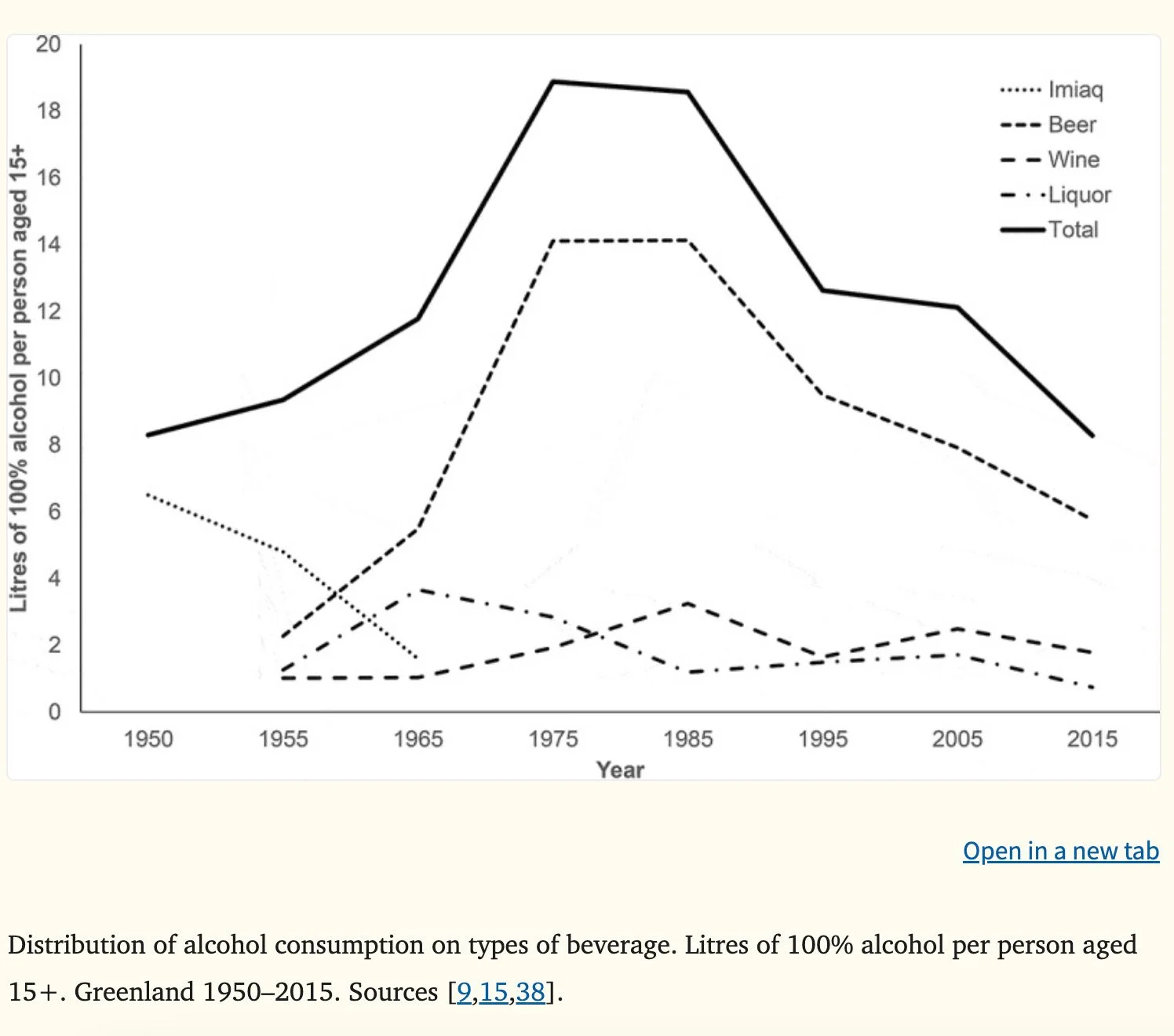
But while it’s true that Greenland was once addled with high rates of alcohol consumption, public-health efforts, economic development, and broader cultural trends have significantly reduced alcohol consumption in Greenland from a peak of nearly 19 liters of pure alcohol per person to a far lower level in the present day, to reach the broader European average for alcohol consumption.

Ironically, against Poulsen’s racially charged comments, public health researchers have also shown that a significant contributor to excess alcohol consumption was likely due to an influx of hard-drinking Danish residents in the 1960s and 1970s:

From 1988 to 1993 the percentage of Danes in Greenland decreased from 17.6% to 13.7% and these have been shown to have a 42% higher average consumption of alcohol than the Greenlanders. It was further estimated that around 1970 about half of the excess consumption of alcohol in Greenland compared with Denmark was due to the higher consumption among Danish men in Greenland.

Tapping Into Grievances

Against this backdrop, in a move no doubt designed to rattle Denmark’s government, Trump sent his eldest son, Donald Jr., to Nuuk in early January “with a message from his dad” to Greenlanders: “We’re going to treat you well.”

As Donald Jr. said to Fox’s Sean Hannity that same week, presumably in coordination with his father:

They’re obviously part of Denmark, but Denmark doesn't allow them to utilize their natural resources. So many of these young kids coming up and telling us on a daily basis 'when we go to Denmark, we're treated like second and third-class citizens. They tell us to go home.' There seems to be quite a bit of racism there.

This is rich coming from a political leader who has turned white supremacy and hard ethonationalism into fundamental pillars of the MAGA movement. And it is pure hypocrisy: There is no reason to believe that Greenland’s people would face better conditions under U.S. governance. For insight into how the country treats its territories, look no farther than to Puerto Rico, where the power grid collapsed on New Year’s Eve of 2024, a result of years-long neglect and underdevelopment.

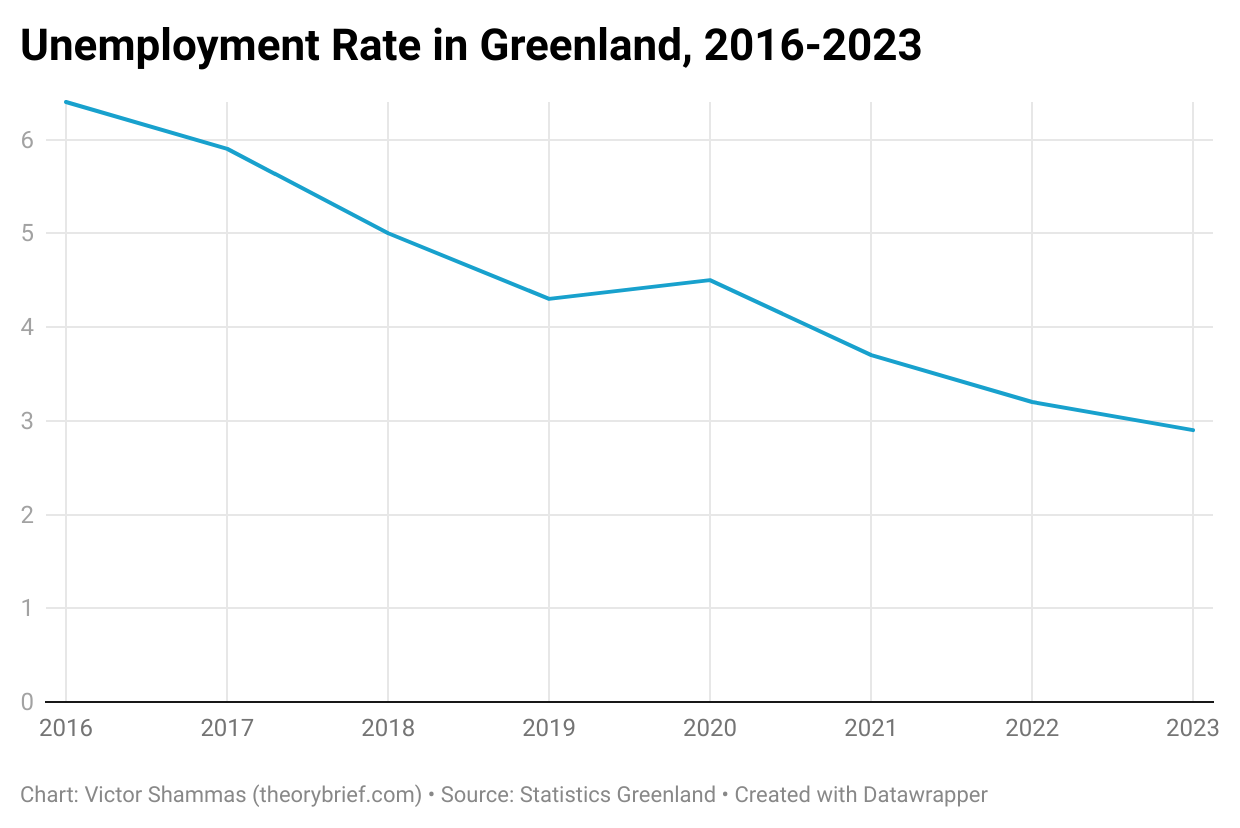
Greenland’s economy, too, is in relatively good shape. By 2023, its unemployment rate was at a historic low of 2.9 percent after strong and steady growth over a decade. Seafood exports combined with Danish government transfers have netted Greenland a reasonably robust, if state-dependent, single-sector economy: Its GDP per capita in 2021, exceeding $57,000, was higher than that of countries such as Canada, Germany, the UK, and France.

Of course, it would hardly be difficult for the U.S. to match and outspend the Danish state given that its economy is more than 50 times larger than Denmark’s. But it seems highly unlikely that American neoliberalism could offer a higher living standard than Scandinavian social democracy. And yet there are, as noted, real historical and contemporary complaints to be made against the Danish state and society in Greenland. Combine that with Trump’s threats to put tariffs on trade with Denmark if he doesn’t get his way, and who can tell which way the wind might finally blow in the Arctic north?

Madman—or Imperial Reason?

There is, of course, something so fundamentally bizarre about the prospect of one NATO member state appropriating the terrain of another NATO member state. Didn’t the Western world just spend hundreds of billions of dollars funding a major war effort in Ukraine in support of the principle of territorial inviolability?

It would be a mistake to reduce Trump’s desire for Greenland to purely rational geopolitical terms. This is not how his mind works or political instincts function. In Fear: Trump in the White House, Bob Woodward recounts how Trump’s short attention span meant that advisors could routinely pull documents from his desk to distract him from irrational policy ideas, such as annulling the U.S.-South Korea free-trade agreement, KORUS, which most agreed was a terrible idea. Trump is at times a creature of such short-lived fixations and cravings.

Still, there is an element of functional performance to his ravings. Trump’s single greatest foreign policy influence is surely Nixon’s madman theory, by which the nuttier the performance, the greater the chance of success. To rationally maximize profits you sometimes have to play the lunatic king, on Nixon’s, and now Trump’s, view.

To his real-estate developer’s eye on the world, Greenland makes just as much good sense as the Panama Canal and Canada, which Trump now also covets:

Canada and the United States, that would really be something. You get rid of that artificially drawn line and you take a look at what that looks like, and it would also be much better for national security. Don’t forget, we basically protect Canada.

Imperialists build empires. If you have the world’s best-funded military force ($824 billion in 2024) and the world’s biggest economy ($29 trillion), what’s the point if you can’t use them to advance your interests? In this regard, Trump is simply playing the straightforward colonial/imperial power game of absorbing or dominating proximate terrains, from Canada to Greenland to the Panama Canal. Don’t be surprised if tomorrow Trump begins to rave about the desirability of northern Mexico—say, as a “buffer zone” against drug cartels.

What is new is the appeal to the once-colonized population and the deployment of decolonial tropes. George Bush, too, spoke of conquering the “hearts and minds” of Iraqis—but they had, after all, been dominated by a decades-long brutal dictator, and so the rhetoric contained much more of a standard liberal-democratic emphasis on freedom over authoritarianism. What’s different here is that Trump and his envoys are deploying the language of decolonialism: As Donald Jr. said to Hannity, Greenlanders are purportedly treated as “second- and third-class citizens” by Denmark. At a Mar-a-Lago press conference, President-Elect Trump questioned the legitimacy of Danish rule: “People really don’t even know if Denmark has any legal right to it.”

This rhetorical strategy is similar to Putin’s recent appeals to countries in the Global South. Like Trump, Putin is a hardline conservative ethnonationalist; unlike Trump he has decades of experience as an authoritarian strongman, but he has also started branching out into what we might call a vaguely “solidaristic” discourse vis-à-vis the poorer, downtrodden elements of the global order: “The Kremlin has adopted this trend of misappropriating the language of decolonization for its own colonial ends.” As Benjamin Young wrote in Foreign Policy,

Unlike the decolonization movements of the Cold War era, this wave is being driven by opportunistic illiberal regimes that exploit anti-colonial rhetoric to advance their own geopolitical agendas.

This solidaristic diagonalism—appropriating leftist decolonial tropes for the purposes of global imperial ambitions—is in many ways the new preferred language of late-modern imperialism. It shows the fundamental rhetorical malleability and strategic flexibility of both Putinism and Trumpism.

Clearly, the people of Greenland would be wise to rebuff Trump’s latest advances. After all, it’s just Trump’s desire, his brutal desire, to borrow the words of Arthur Miller’s Blanche, only this time dressed up in quasi-decolonial terms to appear to be looking out for their best interests. But Trump’s latest offensive is a simulacra of postcolonialism, pretending to take seriously Greenland’s real concerns about its future, while coveting its resources and geostrategic location.

Replacing a minor (former) colonizer with a formidable global hegemon doesn’t sound much like freedom at all—only further, and perhaps deeper, subjugation.

In Praise of Planning

In our crisis-ridden world, could centralized economic planning, rather than the ideal of free markets, be the solution?

Leigh Phillips and Michael Rozworski (2019). The People's Republic of Walmart: How the World’s Biggest Corporations are Laying the Foundation for Socialism. Verso Books.

What makes this cleverly titled book worth returning to five years after its publication? The authors, Leigh Phillips and Michael Rozworski, develop a deceptively simple argument: Pay closer attention to what major corporations like Walmart do, and less to what free-market ideologues say, and you'll find that most capitalist enterprises operate more like carefully planned command economies than idealized market actors. Centralized planning, far from being relegated to the scrapheap of twentieth-century history, is alive and well at the heart of American capitalism: It lies at the core of what companies like Amazon and Walmart do every day.

While classical economic liberalism espouses the ideal of a self-regulating market, no large corporation can actually live and thrive by the principles of laissez-faire economics: Big business demands lots and lots of planning, which in turn means taking charge of resources and building up what in essence amounts to a giant internal planned economy—an economic dictatorship where resources are commandeered and allocated through managerially enforced plans about what to do, when, and where. Phillips and Rozworski (hereafter P&R) suggest that, when examined more closely, the logistics of a corporation like Walmart—the largest private employer in the United States—resembles more the Soviet State Planning Committee (Gosplan) than any of the stylized notions of market actors envisioned by the likes of Ayn Rand or Milton Friedman.

This may seem controversial, but it really shouldn’t be. In his landmark studies in business history, The Visible Hand (1977) and Scale and Scope (1990), Alfred Chandler showed how large firms in the early twentieth century were more interested in maximizing throughput—the constant churn of raw inputs turned into processed outputs—than they were in maximizing profits; the way to accomplish this was through carefully planned managerial action. All successful business is logistics. A steady, stable flow of inputs to outputs was the only way to maintain the “cost advantage” associated with economies of scale (producing a single thing lots of times over) and economies of scope (producing multiple things using the same operating unit). American capitalism is characterized more by the “visible hand of management,” as opposed to the “invisible hand of market forces,” as Chandler puts it—in other words, the active, interventionist agency of centralized (corporate) planning, rather than the spontaneous, self-regulating actions of market-responsive actors.

Similarly, to P&R, “planning exists on a wide scale within the black box of the corporation,” and companies like Amazon and Walmart are essentially gargantuan command economies. On P&R’s account, “great swaths of the global economy exist outside the market and are planned,” and Walmart is a “prime example.” Its modus operandi punctures a century-old debate about the impossibility of “socialist calculation.” In the 1920s, the Austrian economist Ludwig von Mises claimed that markets were inherently superior to anything socialist planning could devise, simply because of informational complexity: Economic life is inherently too tangled, too multifaceted, involving too many actors doing too many things at the same time for centralized planning to be sufficiently efficient; leave that to the information-transmitting effects of prices in self-regulating markets, Mises posited, and the world would be a far better place. But the Misesian argument against socialist calculation has one major flaw: We already live in a world of capitalist calculation; replace the capitalist head with a collectively-oriented one, able to take into account public needs, and planned economies look far less improbable: “Planning exists all around us, and it clearly works; otherwise capitalists would not make such comprehensive use of it.”

Deepening Democracy

Despite its clever and, to my mind, unobjectionable central argument, The People’s Republic of Walmart is weakened by some of its formal features. There is at times a jarring, jokey tone. The authors could have used better data; this is not a book of social science, and there is little by way of first-hand observation or even interviews; most of its contents are based on press reports, and missing is an account of the nitty-gritty of Walmart logistics, despite the book’s titular promise. And there are entire chapters that don’t make much argumentative sense: Detailing the history of Britain’s National Health Service feels unnecessary to building the case for centralized planning—even if any major public health enterprise must of course involve a great deal of it. A chapter on the USSR contains a potted history of 1920s Soviet state and society, only picking up steam midway through with the story of Gosplan, the Soviet state planning agency.

Still, The People’s Republic of Walmart makes an important, if polemical, contribution to the case for economic planning.

Incidentally, theirs is not an argument in favor of nationalization, the take-over of enterprises by the state. To P&R, nationalization can be quite undemocratic, even if decommodifying, because states are hierarchical, stratifying entities. (To illustrate: Norway’s state-owned oil company, Statoil, was a force for decommodification, strengthening the welfare state’s tax base helping expand public-service provision, but it was hardly democratic: There was no meaningful way for the public to force the Norwegian oil giant to pivot to renewables, for instance, which delayed a green transition in this northern European society.)

Economic planning ought instead to deepen democracy; it has to decommodify, certainly, cushioning everyday life from the tyranny of markets, but it should also intensify popular involvement in economic life. After all, there is curious gap at the core of liberal democracy, in which most workers—and we’re almost all workers—are asked to accept that at least one-third of their lives are to be spent on “islands of tyranny,” on P&R’s apt phrase, those economic dictatorships known as the modern workplace, in which time belongs to another—managers, owners—with limited influence on the allocation of means or selection of ends. Why should democracy end at the factory gates?

Some critics have charged that P&R confuse two distinctive concepts: economic planning and planned economies.

I’m not so sure. Clearly, the two are related: If one accepts that corporations in fact engage in lots of long-term planning, then joining up these entities into some kind of coordinated superentity seems more like a technical challenge than an a priori impossibility—a tractable problem of computation, not an article of dogmatic impossibility. Still, more work clearly needs to be done on the move from internal to external, economy-wide planning, in which centralized allocation mechanisms might govern firm-to-firm relations, subject to some form of democratic control.

From Punch Cards to Big Data

P&R are optimistic about the possible role of technology. Sheer computer-processing power should allow us to engage in centralized coordination in ways that a twentieth-century figure like the Austrian socialist Otto Neurath could only dream of. Was planning plagued by inefficiencies because its earlier proponents were trying to do too much with too little? Supercomputers and "big data promise to solve planning and calculation problems that were irresolvable in the former age of typewriters and punch cards. Future work needs more input from the mathematical and computational sciences, P&R argue: Many planning theorists have “come from the academy, in particular from the humanities—history, law, philosophy, literature—and from the social sciences—sociology, anthropology, economics, political science,” but, they argue,

Any future Left that takes the question of planning seriously will also have to depend heavily upon talents from computer science, operations research, combinatorics and graph theory, complexity theory, information theory and allied fields.

At the end of the day, do we even have a choice? In an unequal world and on an overheating planet, planning looks increasingly imperative. The world faces a calamitous series of decades ahead. Climate catastrophe looms large on the horizon. Can we really allow corporations to blindly obey the dictates of the market, prioritizing their shareholders in self-directed fashion? Precious resources, including energy and emissions, need to be allocated in sensible ways. Strangely, Walmart has done a great service to calculation debates by showing that planning is not just some relic of the past but integral to contemporary capitalism. What remains is to show how this might scale up to entire economies—to counteract some of the fundamental crises of our age.


Originally published in The Theory Brief.

The Reagan Dream

Trump is no Reagan: While conservatives aim to conserve, extremists want to push against all limits, venturing into the great beyond — a potentially abyssal, violent beyond.

Reagan (2024). Directed by: Sean McNamara. Starring: Dennis Quaid, Penelope Ann Miller, Jon Voight. (IMDb)

I must confess that Ronald Reagan’s appeal has always mystified me somewhat. Reagan (2024) the movie goes some way toward filling in the blanks, and anyone interested in thinking critically about U.S. politics would benefit from watching it. Despite being widely panned by critics—it currently holds a putrescent eighteen-percent score on Rotten Tomatoes—the film helps account for the long-standing appeal of conservatism in American society. Perhaps in spite of itself, it also demonstrates just how far conservatism has fallen, to such a degree that Trump’s MAGA movement now bears little resemblance to its ideological forbears.

The lead actor Dennis Quaid portrays Reagan as a down-to-earth, essentially likable, folksy, hard-working man motivated by transcendental values: a rock-solid faith in the Lord. Cynically urbane secular liberals may roll their eyes at Quaid/Reagan’s almost childlike pieties, but it is worth bearing in mind that even in 2024, some three-quarters of the U.S. population believes in God, and much of what passes for politics in America is really secularized political theology. In a short and surprisingly moving scene—part of a hectic newsreel montage effectively cutting through multiple decades—Quaid/Reagan prays for his mother’s soul: “Thank you, Lord, for my mother. Take care of her—I know you will. Your faithful servant has come home.” Anyone who doesn’t understand the scene’s strange potency, including a future president prostrate before the Absolute, will never really be able to grasp the U.S. political situation.

But besides relaying some of the comforting qualities of religion, and seemingly by implication conservatism, Reagan paradoxically ends up showing just how dated traditionalist conservatism now feels: Trump is expressly not a conservative but a radical; not so much a traditionalist as an extremist—threatening to deport 18 million undocumented immigrants, for instance, or plotting to variously bomb Mexico or deploy kill teams across the U.S.-Mexico border, or buy (extract) the territory of Greenland from Denmark, or defending white nationalists as “some very fine people.” Trump represents something far more sinister than Reagan’s crude mix of neoliberal economic policy and social conservatism: MAGA is at once a violent intensification of conservatism and a mutated deviation from it. Conservatives, lest we forget, want to conserve; extremists, on the other hand, want to push against all limits, venturing into the great beyond—a potentially abyssal, violent beyond.

Above all, Reagan tries to communicate an essential decency said to be at the core of the conservative project; say what you will of Regan’s administration, but at least he didn’t plan on populating his cabinet with thuggish, tattooed buffoons or suspected predators and criminals. The film celebrates 1980s conservatism with great sentimentalism and nostalgia, even if its overall message is built on a mirage: Reagan himself was a joyful participant in the project of racialization and demonization of the poor (railing against “welfare queens,” for instance), equated concentration camp victims with 18-year-old Nazi soldiers (in the so-called Bitburg controversy), and viciously attacked organized labor (e.g. shutting down the PATCO strike in 1981), to name just a few benighted episodes from his presidency.

But the affect of nostalgia is highly effective, politically speaking. No wonder, then, that Trump himself has tried to tap into the nostalgic allure of Reagan and siphon it off for his own political gain: Quaid himself has come out in support of Trump, personally appearing in pro-Trump rallies ahead of the 2024 presidential election, and at a campaign rally, Trump praised the movie:

I thought the movie was great. Dennis Quaid is here. [Turning to Quaid] Did you like Reagan? He liked Reagan. I think you have to like Reagan to play him that way. You did a beautiful job.

The irony, of course, is that it is a job so beautiful, to speak in Trumpisms, that the movie actually ends up undermining the broad ideological project it seems to want to uphold; Reagan feels cheap and cheesy, on the whole, but it effectively draws attention to the abysmal state of the contemporary Right, if only by way of contrast; as Noam Chomsky has said, the GOP is not so much a political party as a "radical insurgency.” The supreme irony is that the Right of today owes everything to Reagan and his political legacy—and so we must pass beyond Reagan the movie, to Reagan himself, and to the political events that followed in his wake, in an attempt to parse how we got from there to here. On this point, the film remains silent.


Originally published in The Theory Brief.

How to Buy Power and Influence People

Elon Musk's Twitter takeover makes little business sense, but it has given the world's richest man a global megaphone and easy access to Trump's incoming second White House.

Zoë Schiffer (2024). Extremely Hardcore: Inside Elon Musk's Twitter. Portfolio. 330 pp.

We all live in Elon Musk’s world now—and as Zoë Schiffer shows in this meticulously researched book on Musk’s 2022 Twitter takeover, it is a bizarre, dysfunctional, and despotic world.

After reading Extremely Hardcore (Musk’s phrase describing the work culture he expected at Twitter), it is extremely difficult to maintain the illusion that Musk is some kind of business genius: Musk spent $44 billion to acquire a company worth only around $25 billion, effectively overpaying $19 billion, or the gross domestic product of a small country. Moreover, Musk has failed to turn Twitter/X into a profitable venture despite a ruthless slash-and-downsize program of corporate austerity. How, then, to make sense of the contrast between the outward myth of genius and the interior corporate dysfunction? Schiffer’s eminently readable blow-by-blow account of Musk’s Twitter acquisition raises the question: Is the world’s richest man still a rational decision-maker? 

Schiffer’s book excels at bringing together the loose strands of the Twitter/X acquisition and its aftermath. Schiffer shows how Musk’s management strategy is essentially tyrannical, part-Logan Roy of HBO’s Succession, part-Stalin’s court, mixed with a heavy dollop of social awkwardness. In one episode described by Schiffer, a cost-cutting exercise with around forty department heads who were called in for a face-to-face meeting with Musk ended with one head fired for daring to express disagreement:

‘We were ready to show how hardcore we are,’ said one attendee. The group spent the day going through the budget line by line. After one woman tried to argue for an item that Musk did not find necessary, he fired her on the spot. ‘You can be wrong, but don’t be confidently wrong,’ he warned the group.

In another episode, after noticing that engagement with his posts was dropping, Musk demanded to know what was wrong with Twitter’s algorithm. An engineer, Yang, explained that the root cause was Musk’s own downward-trending popularity as a public figure: “He called the issue a “popularity drop” and pulled up the Google Trends graph, showing Musk the jagged downward slope that mirrored his decline on the platform.” Here’s Schiffer’s account of the aftermath:

Musk’s hands were starting to shake. Yang didn’t notice, but [another engineer, Randall] Lin did—he was watching Musk closely and saw the crash coming from a mile away. Shut up, man, he wanted to yell. Just stop talking.

When Yang finally did stop talking, Musk fired him on the spot.

In some ways, of course, there’s no mystery to Musk: He’s just a ruthless manager and capitalist owner rolled into one. He went into Twitter trying to cut costs down to the bone: “The fact that Twitter had a contract in place was not a good enough reason to keep paying. Musk said the only place that made Tesla sign paperwork was the DMV and urged people to try to negotiate every deal down by at least 75 percent.” Cut, cut, cut: This was the “secret” formula Musk brought with him into Twitter’s San Francisco headquarters. This owner/manager role is an unusual combination in today’s world of distant, hands-off owners who have outsourced day-to-day operations to a professional managerial class. Musk’s formula of what we might call charismatic accumulation hinges on the bravado of extreme wealth combined with ascetic discipline (of self) and ruthless tyrannizing (of others). So far this formula has worked reasonably well with Tesla and SpaceX. But has the formula run out of steam?

Buying Global Influence

Measured in purely business terms, the Twitter deal does look like a failure. The company was never very lucrative, even before Musk’s purchase. Over a decade, it only turned a profit twice, and in the two years pre-Musk’s takeover, Twitter lost around $1.3 billion in total. Musk took this less-than-stellar company, paid almost twice what it was worth, fired a huge chunk of its talent base, and pulled the platform rightward. Musk’s moves have caused thousands of intellectuals and media workers to flee for bluer skies and threaten to deepen X’s identity as a weird “alt-tech” social media platform, like Truth Social or Parler, rather than a more capacious global marketplace of ideas. As Schiffer shows, all of Musk’s attempts at instituting a subscriber-payments model or stopping the hemorrhaging advertising revenue losses have largely failed.

But what if monetary profit was never the point? Before the 2024 U.S. presidential elections, Musk reached 200 million followers on X, and much of Schiffer’s book details how Musk pushed and prodded X engineers to rework the algorithm to favor his account. What if the loss-making Twitter deal was really aimed at paving the way for political influence? Despite the conspicuously negative business side of the 2022 acquisition, Musk’s political power and global influence have never been greater. He is now in many ways Trump’s right-hand man, appearing alongside the incoming second-term president-elect in numerous private settings, from transition planning in Mar-a-Lago to rocket-gazing in Brownsville, Texas. Alongside Vivek Ramaswamy, Musk has been promised a chance to run the upcoming Department of Government Efficiency, or DOGE, threatening to turn Ayn Randian principles of minimal government into White House policy.

What Musk bought with his $44 billion was not so much a middling social-media business: As Schiffer points out, Musk could have built a Twitter clone at a far lower cost, like Mark Zuckerberg’s Meta did with Threads. Instead, Musk bought friends and influence in the highest of places. X may be a spiraling business, but it is still an effective megaphone. Musk may even have helped swing the vote for Trump, even as we should be wary of reductive accounts of election outcomes, which are shaped by multiple levers of causality.

Still, what Musk bought in 2022 wasn’t yet another company for his portfolio: He has plenty of those, from Neuralink to SpaceX and Tesla. Instead, Musk bought political power and the chance to help steer the world in his preferred direction. When you’re the richest man in the world, what remains are all the kingdoms of the world and their glory. You might just be able to put a price tag on that—a $44 billion price tag.


Originally published on The Theory Brief.

Fascism vs. Centrism

The stakes have seldom been higher. Enabling the rise of neofascism would be a historic mistake for the left.

Today is Election Day in the United States, a defining moment not just for the U.S. but for the world as a whole.

In these final moments, how should we think about Donald Trump’s candidacy? I recently listened to Joe Rogan’s 3-hour interview with Trump (so that you don’t have to), and Rogan is right to point out that Trump has “comedic instincts,” engages in a form of “stand-up,” and often performs with “great timing.” Trump’s flair for self-deprecation no doubt helps explain his political success. He is, at heart, a performer. By comparison, centrist Democrats often feel wooden—the gap between Biden and Trump is the distance between modernist self-seriousness and postmodern playfulness. But with her charisma, Harris has been far more successful at circumventing this obstacle than her predecessors.

Trump’s comedy, however, is for a narrow set: His is not a universalist playfulness. To those maligned during the October 27th Trump rally in Madison Square Garden, the jokes come with an existential bite. Trump’s court jester, Tony Hinchcliffe, spoke of a “floating island of garbage...I think it's called Puerto Rico”—hardly likely to endear Trump’s campaign to voters of Puerto Rican, Hispanic or Latino descent.

Trump’s Neofascism

Behind Trump’s jokey facade is the beating heart of a fascist. On Rogan’s podcast, Trump spoke of Kamala as a “low-IQ person,” an “imbecile, literally,” the kind of pseudoscientific discourse about intelligence typifying the far right and playing on racist, misogynist ideas about successful Black woman—and made all the more absurd in light of Harris’s considerable credentials. Trump also evidenced a weird obsession with his Air Force One pilots, which he likened to “perfect specimens,” a strangely clinical term, with one pilot said to be a “perfect-looking human being,” a fethishization of military aesthetics familiar to viewers of Leni Riefenstahl’s cinematography.

More centrally, Trump repeatedly invoked an image of foreign and/or criminal Others set on destabilizing the American social fabric, a classic fascist move, with “hundreds of thousands of criminals” said to be overrunning American communities, including “convicted rapists, drug dealers, drug lords.” Trump claimed that Springfield had “32,000 migrants dropped in,” all of them Haitians, and, surprisingly, “they speak no language.” Rogan corrected him: “No English, you mean?” But Trump doubled down on his claim. The idea that Haitians possess “no language”—a smear that has deep historical roots, involving the denigration of Haitian Creole—was likely intentional, reducing a vulnerable, hard-working immigrant community to language-less animality. Portraying minorities as barbaric (literally, those who, from the ancient Greeks’ perspective could only say bar bar, or meaningless, guttural sounds) is straight out of the far-right’s playbook. 

Unsurprisingly, one of Trump’s crucial final rallies took place at Madison Square Garden, perhaps referencing the 1939 Nazi rally in the same location. Back in 1939, more than 20,000 people gathered to participate in a “Pro America Rally,” sing “The Star-Spangled Banner,” give the Hitler salute, and listen to speakers talking of “job-taking Jewish refugees.” In the 2024 rally, meanwhile, Trump invoked the alleged need to “stop the invasion of criminals coming into our country” and claimed “30,000 illegal migrants were put into a town of 50,000 people” and that “no place can withstand that.” The comedian Hinchcliffe, meanwhile, evoked the idea of an overly fertile domestic enemy, in the crudest, most repugnant terms: “These Latinos, they love making babies too, just know that. They do. They do. There’s no pulling out. They don’t do that. They come inside, just like they did to our country.” 

In How Fascism Works, the philosopher Jason Stanley rightly warns against how dangerous all of this rhetoric—and potential, implied policy—is:

The dangers of fascist politics come from the particular way in which it dehumanizes segments of the population. By excluding these groups, it limits the capacity for empathy among other citizens, leading to the justification of inhumane treatment, from repression of freedom, mass imprisonment, and expulsion to, in extreme cases, mass extermination.

In October 2022, a top Israeli medical official spoke derisively of “the Arab womb,” that is, the idea that Palestinian, or “Arab,” women were overly fertile, with terrifying overtones of racist, misogynistic reductionism (as if all Palestinian women partook of one collective “womb”). Two years later, more than 40,000 Palestinians have been killed on the Gaza Strip. There is a straight line running from fascist words and ideas to fascist actions and policies.

Thankfully, Trump’s neofascism still comes with considerable electoral risk, even in the current political moment. With his recent anti-Puerto Rican statements, and earlier scurrilous claims that Haitians migrants to Springfield, Ohio were consuming pets (“They’re Eating the Cats,” as one New York Times headline read), there is a real chance that the Republican nominee may lose—big time—with Latino and Hispanic voters; recall that Hispanic voters now constitute nearly 15 percent of the eligible voter population and cannot simply disparaged at will. The politics of ethnic identification and voting patterns are ambiguous, of course. But the Madison Square Garden rally may have proved a bridge too far.

Regardless of ethnic affiliation, it is clear what Trump stands for: massive trillion-dollar tax cuts to corporations and the rich, aggressive attacks on minorities and women, and the rehabilitation of fascism as a politically salable ideology.

Harris the Preferable Centrist

Harris, meanwhile, has a Palestine problem. She has been part of an administration that has enabled the Israeli genocide on the Gaza Strip. Disappointingly, Harris has failed to distance herself from the Biden administration’s policies, or offered meaningful assurances on ending the bloodshed. This is likely causing the Harris campaign to hemorrhage voters to not only third-party candidates but just sheer apathy and abandonment of electoral politics altogether. Some pro-Palestine (or anti-genocide) voters may even, misguidedly, choose to vote for Trump, despite the fact that Trump will only stay or worsen the line: Recall that Trump moved the U.S. embassy to Jerusalem in 2017, thereby recognizing it as the capital of Israel despite its annexation of East Jerusalem. And back in April 2024, Trump said that Israel needed to “finish what they started” and “get it over with fast”—hardly the words of a peacemaker. Everything suggests Trump will maintain or deepen the Biden administration’s policy stance on Israel/Palestine.

The crucial difference between Harris and Trump is that Harris remains a centrist neoliberal—a kind of Emmanuel Macron transposed across the Atlantic—while Trump is a neofascist. For leftists, the choice is one between two evils, yes, but one of the sides is clearly—by a wide margin—the lesser evil. The political calculus is, in this sense, clear and unambiguous, the choices and overall electoral context being what they are. For those who care about economic redistribution, too, Harris is clearly the preferable candidate: While Trump’s taxation and spending policies will allow the rich to grow richer, Harris’s policies will likely raise the incomes of the poorest one-fifth by nearly 20 percent, while making the top 0.1% pay more than $150,000 in additional taxes by 2026.

Strategic Timing

In this context, the left must learn the hard lessons of kairos, of “the right time,” which is to say strategic timing: The situation is not right for a third-party vote. For activists eager to punish Biden, the right response in the long term is to build a mass movement capable of pulling Democrats leftwards. For the near term, the leftist activist and writer Joe Mayall has produced an exemplary analysis of the concrete situation facing progressive voters. His analysis comes down to one basic insight: Harris and Trump are not the same; in total, Trump is far worse: “Domestically, the boilerplate Democratic politics of Harris are preferable to the MAGA agenda.” Given the grievous threats of Trumpism, Mayall argues that compromise is the order of the day:

This “compromise” is leftist voters casting ballots for Harris, so that we are not “hurled into battle” against the army of Donald Trump, who wants to “use the military to handle the radical left. I’m not sure what Trump means by “handle,” but I know none of us will be able to advocate for Palestine, abortion rights, or socialism from a jail cell, camp, or grave.

I also agree with the anthropologist Vito Laterza, a theorist of political communication:

Yet, this remains a binary contest - that is the nature of the electoral rules in America, rules that could use some changes, but these are not changes that will occur now or in the foreseeable future. Dispersing votes for third-party candidates on the left effectively gives a hand to Trump. And voting for Trump just doesn't make any sense. Not on any of the issues that Harris and Walz confidently stand for - and not on Palestine and Israel.

It would be a historic mistake for progressives to depress the vote for Harris, thereby enabling Trump’s return to power. Doing so won’t help the Palestinians; it will, however, harm women and ethnic minorities inside the United States; and it will create four years of instability, unpredictability, and potential chaos on the global stage. Neither liberal democracy nor the world as we know it may survive a second Trump term. As Trump himself told a group of evangelical voters in July: “In four years, you don't have to vote again.”

For once, we may take him at his word.